A Locally Led Model for Sustainable Laparoscopic Surgery at Madda Walabu University Goba Referral Hospital
Madda Walabu University Goba Referral Hospital has built a locally led, multi-partner model for laparoscopic surgery. More than 500 patients have been served in an area that previously had no access, and local capacity is growing through tr
Author: Kebebe Bekele
· 3 min read
More photos · 5
International collaboration is not always easy, even for highly experienced professionals in Europe. Busy schedules, travel time, logistics, and rising costs can make continuous international movement difficult.
For this reason, Madda Walabu University Goba Referral Hospital developed a collaborative, locally led model to build sustainable laparoscopic surgical capacity.
Our Model 1. Clear and Shared Objectives
Our primary objective is to establish a strong, sustainable laparoscopic surgery and training center in Ethiopia that serves patients while developing local surgical expertise.
2. Multiple International Collaborators
Instead of depending on a single partner, we work with multiple surgeons, universities, organizations, and NGOs. This gives our local team broader exposure to different techniques, technologies, training systems, and models of care.
3. Local Leadership and Ownership
The project is locally initiated and locally led. International partners provide expertise, training, equipment, and mentorship, while the local team remains responsible for implementation and continuity. This builds sustainable capacity rather than dependence on visiting teams.
4. Mobilizing Resources Through International Partners
Many international organizations have contributed equipment, consumables, training, and technical support. Next Thursday, another shipment of laparoscopic equipment and surgical supplies, valued at approximately €100,000 (around ETB 15 million), is expected to arrive.
5. Developing Local Human Capacity
Three local staff members have already received substantial laparoscopic training, and two more are currently in training. This led to a major milestone: a laparoscopic surgical campaign led by local staff, showing that international collaboration can become locally sustainable surgical capacity.
6. A Laparoscopic Training Laboratory
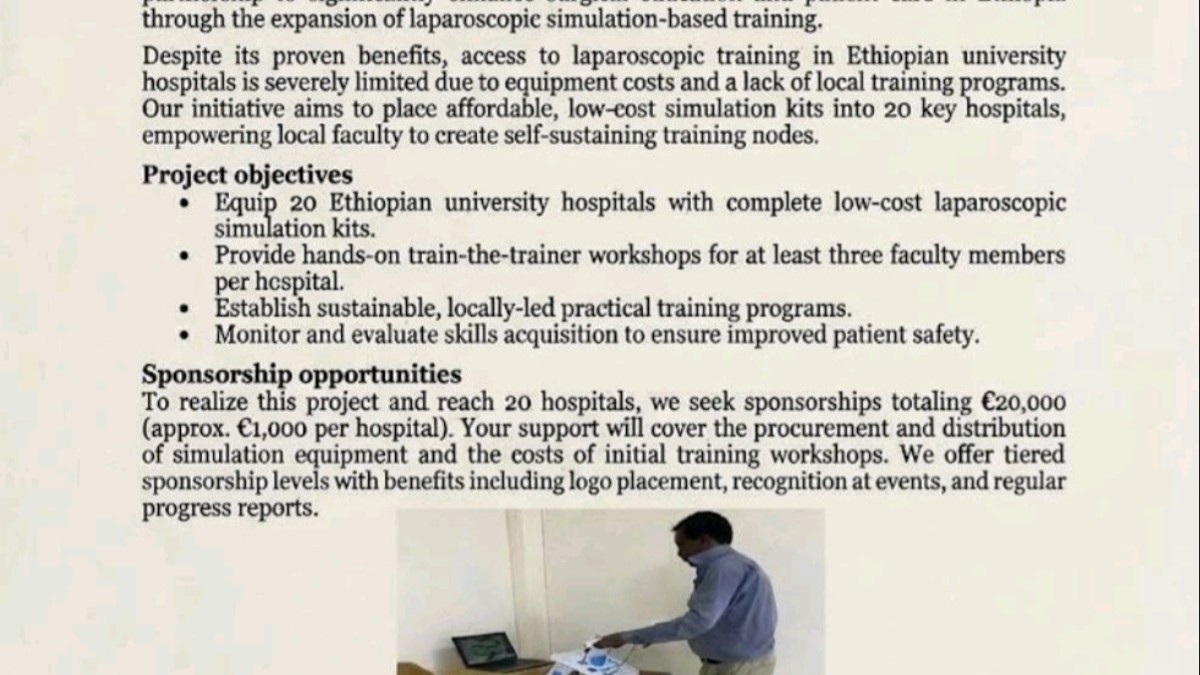
A dedicated laparoscopic training and simulation laboratory is being established. It will support continuous training for surgeons, residents, nurses, and other operating-room professionals, and extend laparoscopic skills beyond the initial team.
7. Two Laparoscopic Towers and Essential Equipment
A key goal is to equip the hospital with two laparoscopic towers and other essential equipment. This will improve operating-room capacity, reduce interruptions caused by equipment limitations, support simultaneous training and clinical work, and secure the long-term continuity of laparoscopic surgery.
8. Impact on the Community
More than 500 patients have received laparoscopic surgical services through this initiative. Before the project began, no patients in this area had access to laparoscopic surgery. This is a major improvement in access to specialized care.
9. Promoting Ethiopia and Madda Walabu University Globally
We share this project with surgeons, universities, professional organizations, NGOs, and potential collaborators worldwide. By sharing our experience, achievements, challenges, and goals, we aim to attract new partners, expand training and research opportunities, mobilize resources, and strengthen Ethiopia’s position in the global development of laparoscopic surgery, while keeping collaboration focused on local priorities.
Our work has already received attention from international media and academic institutions, including media in the United States, Greece TV, Milan University, and Italian newspapers.
10. Contributing to Foreign Currency Earnings
Each year, more than 30 to 40 international professionals and collaborators come to Ethiopia through this project. They fly with Ethiopian Airlines, stay in local accommodations, spend on meals and transportation, and take part in tourism and local activities. The project therefore supports not only surgical capacity but also the local economy and Ethiopia’s foreign currency earnings.
The Key Lesson
International partnership does not have to mean continuous dependence on international travel or visiting teams. The most sustainable model combines international collaboration with strong local leadership.
International partners bring knowledge, technology, mentorship, training, and resources. The local team provides leadership, continuity, adaptation to the local context, and long-term implementation.
This approach has helped Madda Walabu University Goba Referral Hospital move from limited access to laparoscopic surgery toward becoming a locally driven center for laparoscopic surgery, training, and innovation in a low-resource setting.
Gratitude
Thank you to everyone who has contributed to bringing this project to this stage, both organizations and individuals, in Ethiopia and abroad.